For French fry processing plants, fresh-cut vegetable processing companies, and agricultural product processing plants, a potato washing and peeling machine with stable performance not only improves production efficiency but also directly impacts the quality of subsequent processing steps such as cutting, blanching, and packaging. When selecting equipment, many buyers focus not only on production capacity but also on how the machine actually performs the washing and peeling tasks, as well as which design features ensure consistent processing results.
The First Step After Potatoes Enter the Machine: Uniform Tumbling Wash
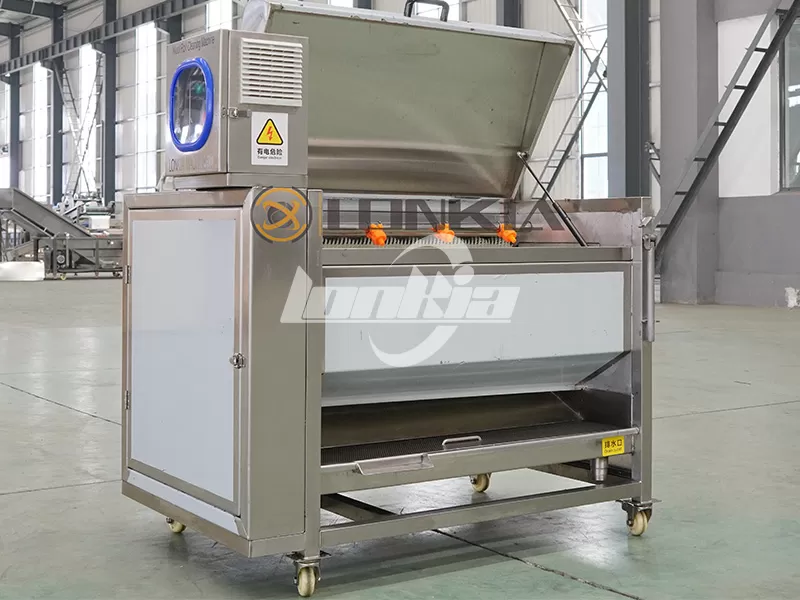
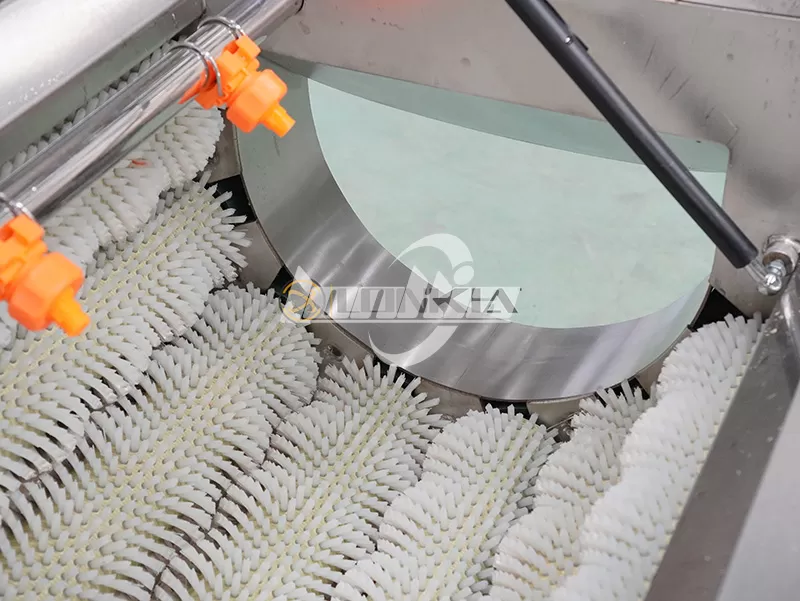
Once the potato washing and peeling machine starts, the potatoes enter the washing chamber, where they continuously tumble driven by the rotating brush rollers, ensuring that each potato comes into full contact with the brushes. At the same time, the overhead spray system continuously supplies water, promptly rinsing away dirt, sand, and impurities from the potato surfaces to prevent residue from affecting the peeling process later on.
This combined process of tumbling, brushing, and spraying ensures that all parts of the potatoes are subjected to uniform force, improving the consistency of the overall cleaning and creating optimal conditions for subsequent peeling.
How Do the Brush Rollers Achieve Uniform Peeling?
The brush rollers are the core components of the potato washing and peeling machine and a key factor determining peeling effectiveness. The industrial potato washer uses multiple sets of brushes rotating in sync to keep the potatoes constantly rolling and rubbing against each other, gradually removing the outer skin while preserving the potatoes' integrity as much as possible.
High-quality brushes are wear-resistant and resistant to deformation, ensuring stable peeling performance over extended periods. Depending on specific processing requirements, brushes of varying hardness can be selected to balance peeling efficiency with product appearance quality.
Automatic Continuous Operation for Improved Production Stability
To minimize manual intervention, the potato washer and peeler machine typically operates continuously. From feeding, washing, and peeling to discharge, each process stage flows seamlessly, requiring operators to perform only basic controls.
Continuous operation not only reduces waiting time but also maintains a steady processing rhythm, ensuring consistent washing and peeling results for every batch of potatoes. It also facilitates integration with other equipment, such as slicers and cutters, to form a complete processing line.
What Design Features Determine the Actual User Experience?
Many customers tend to focus solely on motor power while overlooking the equipment's overall structure. In fact, an excellent potato washing and peeling machine typically features the following key characteristics:
- A 304 food-grade stainless steel body that is sturdy, corrosion-resistant, and easy to clean daily;
- Multiple sets of evenly spaced brushes that ensure thorough tumbling of the potatoes, improving peeling consistency;
- A continuous spray system that minimizes the buildup of mud and sand;
- An automatic discharge design that reduces manual labor;
- A rational structural layout that facilitates daily maintenance and replacement of wear-prone parts.
How Can You Determine if A Machine Is Worth Selecting?
For procurement professionals, a reliable machine must not only deliver excellent washing and peeling performance but also operate stably, be easy to maintain, and be capable of meeting continuous processing demands. We recommend focusing on brush quality, overall material construction, drive system stability, and detailed design features—rather than simply comparing technical specifications.
Lonkia has deep expertise in the field of fruit and vegetable processing equipment and continuously optimizes the structural design of its potato washing and peeling machine. This ensures the equipment delivers stable operation, uniform peeling, and convenient maintenance, meeting the continuous processing needs of various root and tuber vegetables and providing food processing enterprises with more reliable pre-processing solutions.