As food processing companies continue to raise their standards for product quality and processing techniques, vacuum frying technology has gradually been adopted in the production of fruit chips, vegetable chips, and snack foods. Unlike traditional frying, vacuum fryers perform low-temperature frying in a negative-pressure environment. By controlling the vacuum level and oil temperature, they enable food to develop a crispy texture during the dehydration process while minimizing the impact of high temperatures on the color and flavor of the raw ingredients. So, how exactly does a vacuum fryer work? How does it differ from traditional frying equipment?
What Is the Working Principle of a Vacuum Fryer?
A vacuum fryer is a food processing machine that utilizes a low-pressure environment for low-temperature frying. Its core principle involves using a vacuum system to reduce the air pressure inside a sealed frying chamber, thereby lowering the boiling point of water and allowing moisture within the food to evaporate at a lower temperature.
LONKIA vacuum fryers operate at temperatures ranging from 80–120°C, and processing parameters can be adjusted based on the moisture content of the raw materials, slice thickness, and finished product requirements.
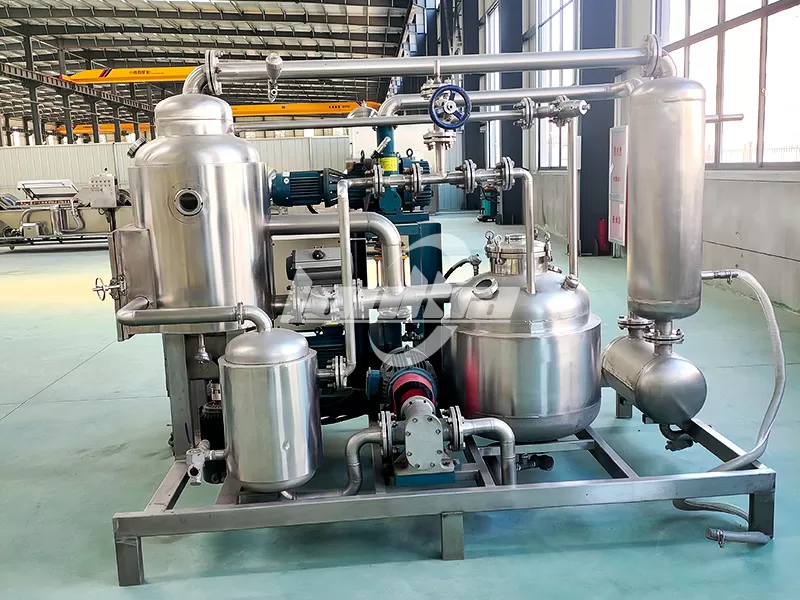
How Does a Vacuum Fryer Process Food?
A vacuum frying machine achieves food dehydration and frying through the coordinated operation of systems such as the vacuum environment, temperature control, and oil treatment. The entire process primarily revolves around the following key steps:
- Establishing a Sealed Processing Environment: After loading the raw materials into the vacuum frying equipment, the frying chamber is sealed. The vacuum system begins operation, gradually reducing the pressure inside the chamber to create suitable conditions for subsequent low-temperature frying.
- Controlling Oil Temperature and Performing Heat Treatment: The heating system raises the cooking oil to the set temperature, and the equipment fries the raw materials under negative pressure. Moisture gradually escapes from the food, causing changes in the raw material's structure and gradually forming a crispy texture.
- Completing Oil Separation: Once the preset processing requirements are met, the equipment uses a centrifugal oil-removal device to separate excess oil from the product's surface, helping to control the finished product's oil content and improve its texture.
- Ending Processing and Removing the Product: After frying and oil removal are complete, the vacuum frying machine terminates the current processing cycle according to the operating procedures, removes the finished product, and proceeds to subsequent cooling, seasoning, or packaging stages.
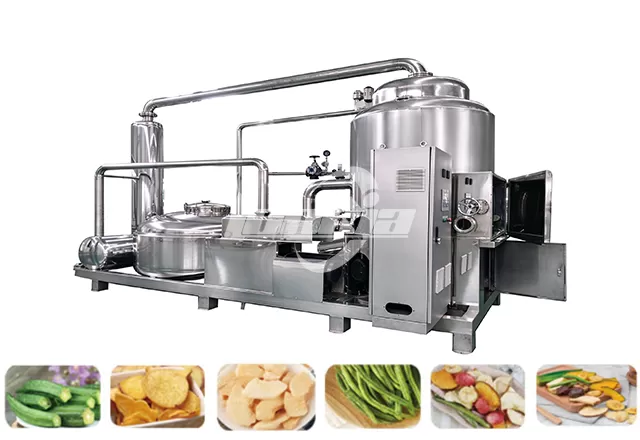
Through the coordinated operation of its various systems, the vacuum deep fryer can adjust processing parameters based on the characteristics of different ingredients, making it suitable for processing a wide variety of foods, including banana chips, apple chips, mango chips, sweet potato chips, and crispy mushroom chips.
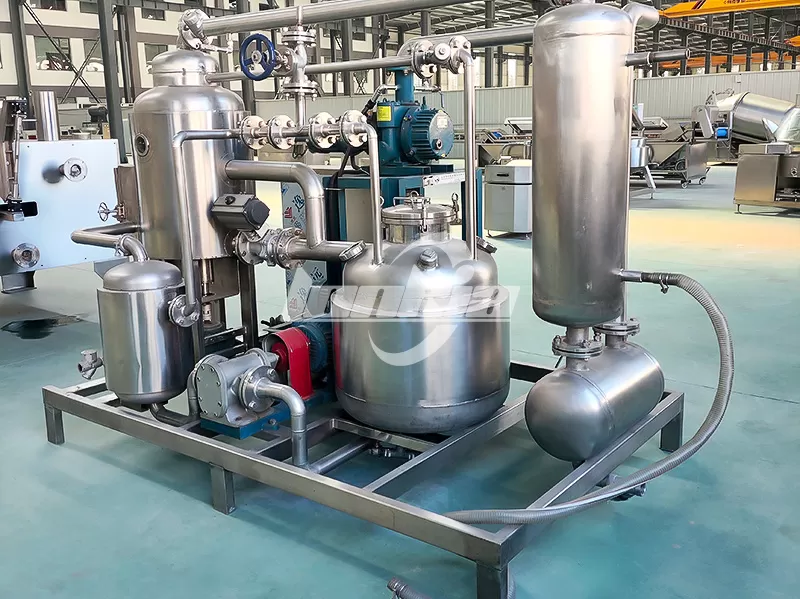
What Are the Core Systems of a Vacuum Frying Machine?
The processing results of the vacuum fryer depend not only on the frying temperature but are also closely related to the coordination of its various functional systems.
1. Vacuum System
The vacuum system uses a vacuum pump to reduce the pressure inside the frying chamber, providing the necessary conditions for low-temperature frying. A stable vacuum environment helps control the evaporation of moisture from the food.
2. Heating and Oil Circulation System
The heating system heats the cooking oil to the set temperature, while the oil circulation system helps maintain a stable oil temperature throughout the processing, ensuring more uniform heating of the raw materials.
3. Centrifugal De-oiling System
Food products may retain some residual oil after frying. The centrifugal de-oiling unit uses centrifugal force generated by rotation to remove excess oil, helping to improve the product’s oil content and texture.
4. Automatic Control System
Operators can set parameters such as frying temperature and vacuum level based on raw material characteristics and product requirements, reducing variations caused by manual operation and improving processing consistency across different batches.
What Is the Difference Between Vacuum Frying and Traditional Frying?
The main difference between the two processing methods lies in the frying environment and operating temperature. Traditional frying typically occurs under atmospheric pressure, while vacuum frying occurs under negative pressure.
Comparison of Methods | Vacuum Frying | Traditional Frying |
Processing Environment | Vacuum environment | Atmospheric pressure environment |
Operating Temperature | Relatively low | Typically high |
Moisture Evaporation | Evaporation occurs at lower temperatures | Primarily relies on high-temperature evaporation |
Product Color | Helps preserve the natural color of the ingredients | Color changes are more likely to occur at high temperatures |
Product Texture | Suitable for producing crispy foods | Textures vary depending on the frying process |
Oil Removal Method | Can be combined with centrifugal oil removal | Typically involves methods such as draining |
For companies processing products such as banana chips, apple chips, mango slices, sweet potato chips, and okra crisps, vacuum frying offers an alternative to traditional frying.
How to Select the Right Vacuum Fryer?
When purchasing a vacuum fryer, it is recommended to focus on the following factors:
- Raw Material Types: Different fruits and vegetables have varying moisture content and tissue structures, requiring corresponding processing parameters.
- Target Production Capacity: Determine equipment configuration based on batch load capacity, processing time, and daily production plans.
- Finished Product Requirements: Clearly define product color, crispness, specifications, and oil content requirements.
- Equipment Configuration: Pay close attention to the vacuum system, heating system, oil circulation, centrifugal oil removal, and automatic control systems.
LONKIA vacuum fryers are manufactured with SUS304 stainless steel for all food-contact parts. They integrate vacuum frying, heating, oil circulation, centrifugal oil removal, and oil filtration functions into a single unit, and equipment solutions can be customized based on raw material types, target production capacity, and process requirements.
If you are looking for vacuum frying equipment suitable for the production of fruit chips, vegetable chips, or other snack foods, please feel free to contact LONKIA. Provide us with the types of raw materials, target production capacity, and finished product requirements, and we can recommend suitable equipment configurations and processing solutions for you.