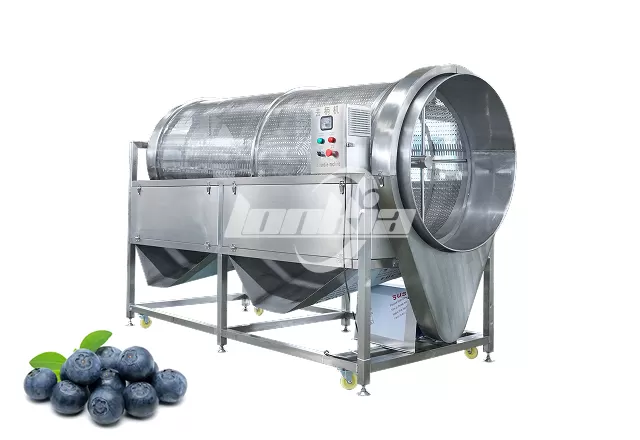
During blueberry processing, pesticide residues and surface impurities have always been among the top concerns for customers. Traditional washing methods often struggle to balance cleaning effectiveness with fruit protection, whereas modern blueberry cleaners achieve higher cleaning standards through structural and technological optimizations. So, can they truly remove pesticide residues? The answer depends on the equipment's design and configuration.
Challenges in Blueberry Washing
Blueberries have a soft skin covered with a natural bloom. If washed improperly, the following issues can easily arise:
- Incomplete cleaning, leaving behind pesticide residues and dust
- Damage to the skin caused by high-pressure rinsing
- Uneven manual washing affects batch quality
This is the core reason why an increasing number of processing plants are choosing blueberry cleaner equipment.
Core Principles of Blueberry Cleaners
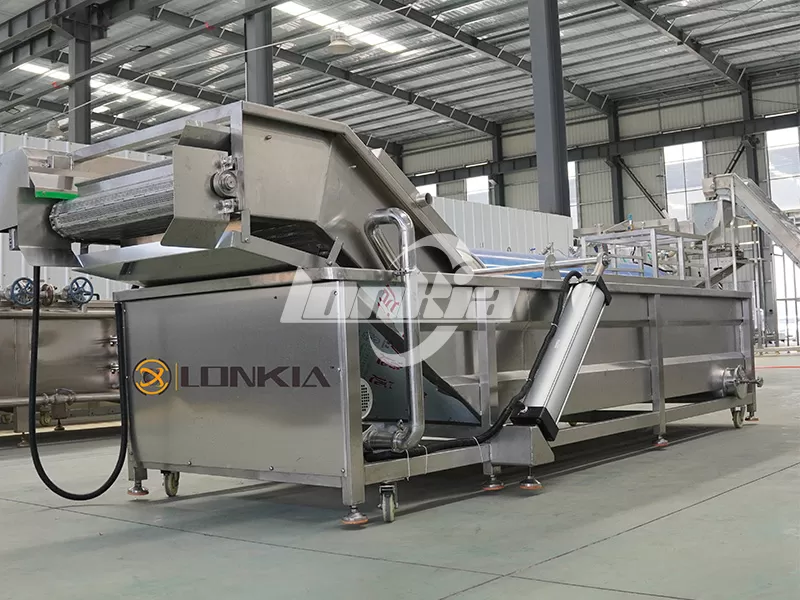
Modern blueberry washers primarily utilize a dual-cleaning structure combining bubbles and spray:
1. Bubble Agitation Cleaning
The blueberry cleaning equipment generates a large volume of bubbles at the bottom, gently agitating the blueberries in the water. The interaction between water flow and bubbles strips away adhering impurities and some pesticide residues.
2. High-Pressure Spray Secondary Rinse
The top spray system performs a comprehensive rinse, further removing residues and ensuring thorough cleaning with no blind spots.
👉 This combination of "agitation and rinsing" is currently the most reliable method for cleaning fruits and vegetables.
Can It Really Remove Pesticide Residues?
The answer is: It can remove most surface pesticides, but effectiveness depends on the configuration
✔ Types of Residues Removed
- Surface-adhered pesticides
- Dust and silt
- Some soluble chemical residues
The micro-impact force generated by bubbles effectively dislodges adherents, while the water flow carries away contaminants
✔ Key Configurations for Enhanced Removal
1. Ozone System (Highly Recommended)
Ozone breaks down pesticide molecules in water, enabling deeper cleaning
👉 In practical applications, removal rates can reach nearly 99%
2. Water Recirculation and Filtration System
- Continuously filters out impurities
- Prevents secondary contamination
- Improves cleaning consistency
3. Adjustable Bubble Intensity
Different cleaning intensities for blueberries at various stages of ripeness, preventing damage while ensuring effectiveness
Advantages of the Blueberry Washing Machine Over Traditional Cleaning Methods
- More Uniform Cleaning: The blueberry cleaning equipment combines continuous tumbling and spraying, eliminating the risk of manual oversight
- No Damage to Fruit: Bubble washing is a gentle cleaning method, ideal for delicate fruits like blueberries
- Improved Cleaning Efficiency: Automated conveying + continuous operation significantly reduces reliance on manual labor
- Standardized Production: Consistent cleaning results across every batch, suitable for export and processing companies
Recommendations for Blueberry Washer Applications
If your goals are "safety + quality + efficiency," we recommend:
- Select a blueberry cleaner with a bubble + spray structure
- Prioritize configuring an ozone system
- Choose the appropriate equipment length and conveyor speed based on production capacity
- Pair with air-drying equipment to improve subsequent processing efficiency
Blueberry cleaning equipment like that provided by Lonkia employs a combination of multiple water streams and bubbles. This ensures effective cleaning while preserving fruit integrity, making it suitable for processing scenarios with high quality requirements.
Conclusion: Is a blueberry cleaner worth the investment?
✔ Significantly reduces pesticide residues on blueberry surfaces
✔ Enhances food safety and product grading
✔ Enables a stable, efficient, and controllable cleaning process
👉 If your core needs are:
- To raise food safety standards
- To reduce labor costs
- To maintain the visual quality of blueberries
Then a blueberry cleaner not only effectively removes pesticide residues but is also a key piece of equipment for achieving standardized production.
For modern fruit and vegetable processing enterprises, it is no longer an "optional piece of equipment" but rather "essential infrastructure."