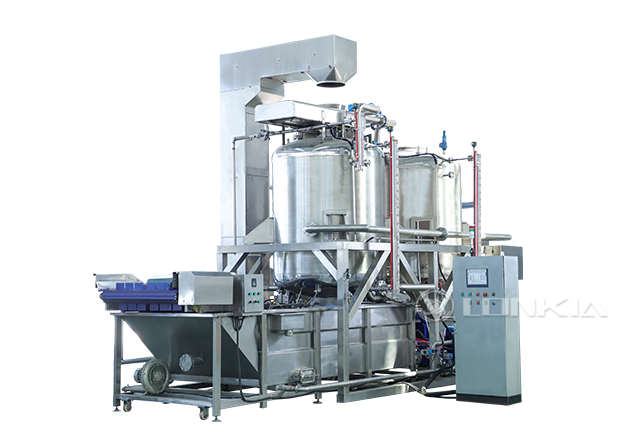
For food processing companies, selecting the right industrial fryer is not only critical to product quality but also directly impacts production costs, equipment reliability, and maintenance efficiency. Currently, continuous fryers on the market primarily use three heating methods: electric, gas, and thermal oil. Many customers face the same dilemma when purchasing: which heating method best suits their production needs?
This article will analyze equipment operational characteristics, temperature control performance, production stability, and suitable applications to help you select the most appropriate industrial fryer.
Electric-Heated Industrial Fryers: Precise Temperature Control, Convenient Operation
Electric heating directly heats the frying oil via heating elements, featuring a simple structure and fast response times.
For products requiring strict control of frying temperatures, electric heating systems offer high temperature control precision, resulting in more consistent product color and texture. Since the heating elements act directly within the oil tank, heating efficiency is high, and operation and management are relatively simple.
Additionally, electric heating systems offer a high degree of automation, making them suitable for production lines with stringent requirements for product consistency.
Suitable Applications
- Potato chips production lines
- Snack food processing lines
- Fried products requiring high-precision temperature control
Gas-Heated Industrial Fryer: Significant Advantages in Operating Costs
Gas-heated industrial fryers use natural gas or liquefied petroleum gas (LPG) as the heat source, heating the oil tank via burners.
Compared to electric heating, gas systems typically provide a higher thermal load and maintain stable heat supply during continuous production. For production lines operating continuously for extended periods, gas heating often offers better economic efficiency.
Additionally, gas systems heat up quickly and can rapidly return to the set temperature when production loads fluctuate, ensuring consistent frying quality.
Applications
- French Fries Production Lines
- Banana Chip Production Lines
- Nuts Frying Production Lines
- Food processing plants requiring long-term continuous operation
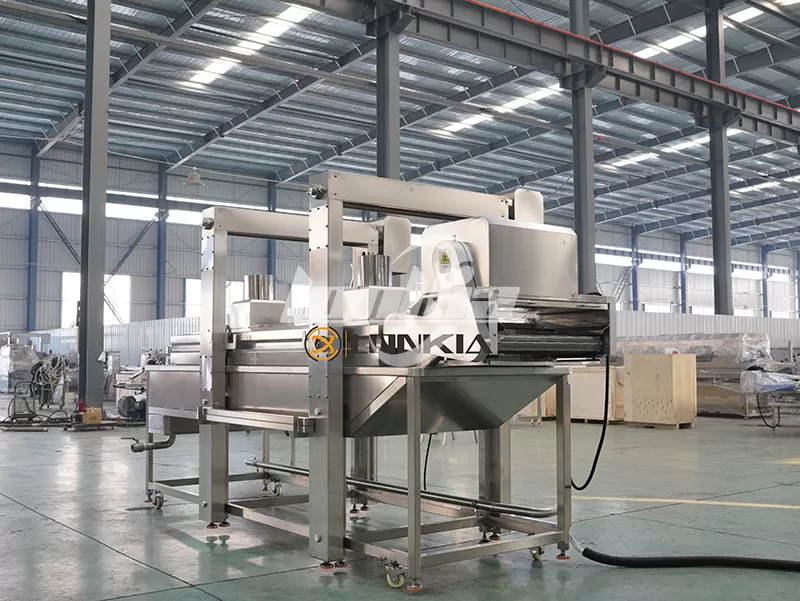
Thermal Oil Industrial Fryer: Suitable for Continuous, Large-Scale Production
Thermal oil heating is an indirect heating method that transfers heat to the frying oil via a thermal oil circulation system.
Compared to direct heating, thermal oil systems achieve more uniform heat distribution, reduce localized high-temperature spots, and stabilize the temperature throughout the entire oil tank. For continuous industrial deep fryer machines, uniform temperature distribution helps improve product color consistency and reduces the risk of thermal damage to the oil.
Many high-capacity continuous frying production lines adopt thermal oil heating solutions, combined with oil circulation and filtration systems, to improve equipment operational stability and product quality.
Applications
- Continuous potato chip production lines
- Frozen French fry production lines
- Battered food production lines
- Projects requiring long-term continuous production
How to Choose the Right Heating Method for Your Industrial Fryer?
When selecting an industrial fryer heating system, it is recommended to focus on the following aspects:
- Product Quality Requirements: If the product has high standards for color, texture, and oil content, prioritize heating systems with superior temperature stability.
- Production Continuity: Facilities with extended continuous production cycles should prioritize the heating system's sustained heat output capacity and operational stability.
- Factory Energy Conditions: Energy supply conditions vary by region; selecting an industrial fryer compatible with local energy infrastructure can minimize operational inconveniences down the line.
- Long-Term Maintenance Costs: After years of operation, ease of maintenance and the cost of replacing parts are also important considerations.
Conclusion
The heating system is one of the core components of an industrial fryer, directly impacting equipment performance and final product quality. When purchasing equipment, companies should conduct a comprehensive evaluation based on product characteristics, production capacity requirements, and factory energy conditions.
As a professional food processing equipment manufacturer, Lonkia offers a variety of industrial fryer solutions—including electric, gas, and thermal oil heating—tailored to different product processing requirements, helping customers achieve a stable and efficient frying production experience. Please contact us for equipment recommendations suited to your project.